
1 article
Pipeline & Conversion
Marketing does not end with a lead. Notes on conversion, measurement, sales alignment, and the systems that turn interest into revenue.
Lead generation is only part of the equation. Strong marketers track revenue, pipeline, and the marketing-to-sales handoff, not lead volume alone.
MJ Habal · July 2026 · 7 min read
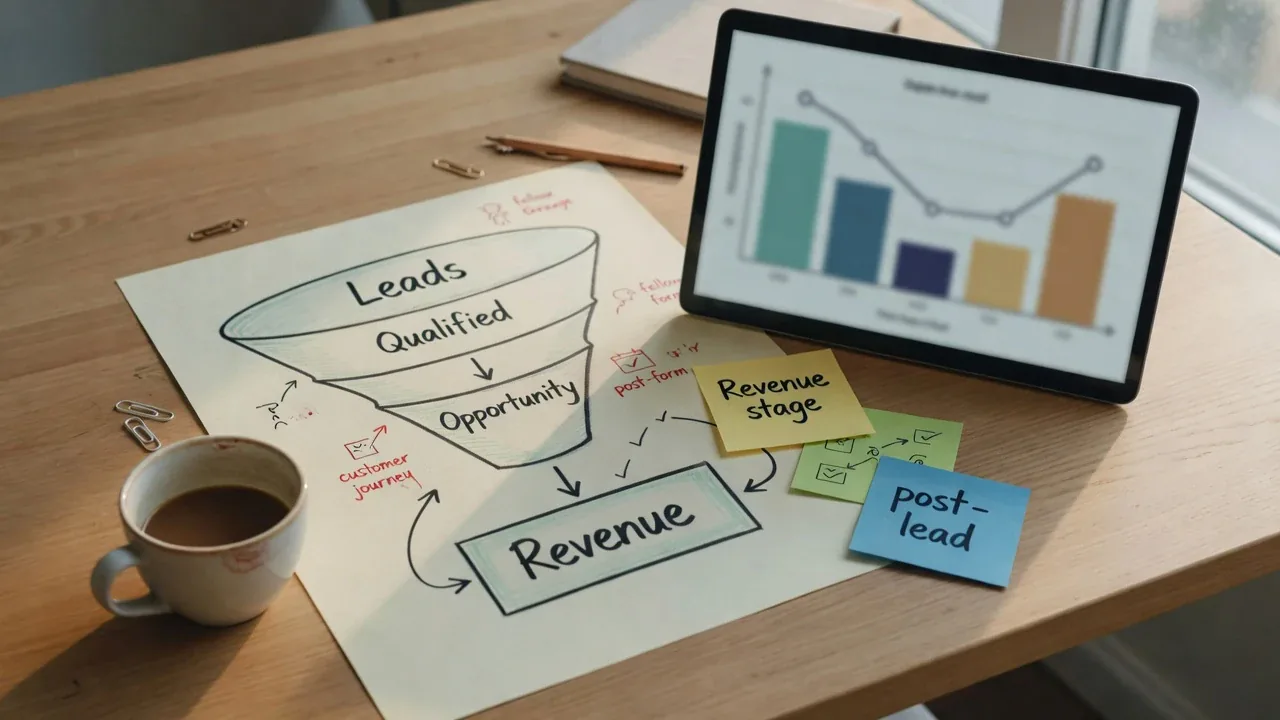
The first time I questioned my role as a marketer wasn’t when a campaign failed. It was when a campaign succeeded.
Traffic was up. Leads were coming in. The reports looked good. By every marketing metric we tracked, things seemed to be moving in the right direction. Yet the business barely felt any different. Revenue hadn’t changed much. Sales wasn’t celebrating. Management wasn’t impressed.
That was the moment I started asking a question I hadn’t thought much about before: if marketing is doing its job, why isn’t the business growing?
The short answer is that lead generation is only part of the equation. Capturing interest matters, but conversion is what transforms interest into revenue. Strong marketers track both. They care less about how many leads they generate and more about how many of those leads become customers.
Lead generation is attracting and capturing potential customers: form fills, calls, Messenger inquiries, demo requests.
Conversion is what happens next: the steps that turn those leads into booked conversations, qualified pipeline, and eventually paying customers.
Revenue is the scoreboard. A campaign can win on traffic, clicks, and lead volume and still lose on growth if the path after the lead is broken.
That distinction sounds obvious. In practice, many marketing dashboards still stop at the lead. That is how teams celebrate activity while the business stays flat.
I remember working on a healthcare campaign where the marketing side was performing well. The messaging resonated, the creatives generated interest, and inquiries were coming in consistently. Yet conversions remained lower than expected.
Our first instinct was to look at the campaign itself. Were we targeting the wrong audience? Was the offer unclear? Were the ads attracting the wrong people?
The answer turned out to be no.
After tracing the customer journey, we discovered that many prospects were dropping off during the initial Messenger conversations. The issue wasn’t visibility. It wasn’t traffic. It wasn’t even lead volume. It was what happened after the lead arrived—a marketing-to-sales handoff and follow-up problem, not an ad problem.
Solving that problem didn’t require better ads. It required improving how inquiries were being handled.
That’s when I realized something important: marketing doesn’t own every stage of the customer journey, but it benefits from understanding every stage of the customer journey.
What made the experience frustrating was that our dashboards only told part of the story. We could see the traffic. We could see the inquiries. What we couldn’t immediately see was where people were dropping off afterward.

Like many marketers, I started my career focused on the metrics marketers are expected to focus on: traffic, reach, clicks, and engagement. These numbers matter because they show whether people are paying attention.
But attention alone doesn’t pay the bills. Those top-of-funnel numbers are often vanity metrics when they are treated as the finish line.
A company can generate thousands of website visitors and still struggle to grow. It can produce a steady stream of leads and still miss revenue targets. Somewhere between attracting attention and generating revenue, something breaks.
The traditional view is simple: marketing generates leads, and sales closes deals. On paper, that division makes sense. Marketing brings people through the door. Sales turns those opportunities into customers.
The problem is that reality rarely follows an org chart. A lead might not convert for reasons that have nothing to do with the quality of the lead itself, including:
None of these issues are necessarily marketing’s fault. But if enough of them exist, the business still suffers. That’s why I stopped thinking of marketing as simply generating leads, and started thinking of it as helping the business identify where momentum is being lost.
If this pattern sounds familiar, the next place to look is usually the handoff itself—response time, routing, and what happens after the form fill.
The longer I’ve worked in marketing, the more I’ve noticed that priorities shift depending on where you sit in the organization.
Junior marketers often focus on impressions, clicks, reach, and engagement. These metrics are useful because they’re immediate and easy to observe.
As responsibilities grow, the conversation changes. You start paying attention to lead quality, cost per lead, and conversion rates.
Move further into leadership, and the questions get broader:
The higher you go, the less anyone cares about clicks in isolation. That isn’t because clicks are unimportant. It’s because clicks are the currency of marketing reports, and revenue is the currency of businesses.
What you put on the weekly dashboard also changes behavior—the metric you report becomes the product you build.
The CEOs and business leaders I’ve worked with eventually ask the same question: why is revenue growing, or why isn’t it?

When revenue falls short, nobody cares which department technically owns the problem. They care about finding the bottleneck.
That’s one reason many respected marketing organizations spend so much time on funnel conversion, pipeline generation, attribution, and sales alignment.
The easiest way to hide a broken business is to give marketing a traffic goal. As long as the numbers go up, nobody has to ask the harder question: is any of this turning into revenue? That’s why marketing teams at revenue-driven companies don’t treat marketing as a lead factory. They treat it as part of a larger revenue system.
Marketing should care about conversion. That doesn’t mean marketing owns conversion. Those are two very different statements.
If a sales team ignores incoming leads, that’s not marketing’s fault. If pricing is uncompetitive, that’s not marketing’s fault. If the product fails to solve a meaningful problem, that’s not marketing’s fault either.
But a good marketer stays curious about those issues, because they affect the outcome everyone ultimately cares about.
A marketer can say, “We generated 1,000 leads,” and technically be correct.
A stronger marketer asks: what happened to those 1,000 leads? How many became customers? How many disappeared? Where did they drop off? What prevented them from moving forward?
Those questions often reveal more about the health of a business than any dashboard ever will.
Sometimes the answer is better SEO. Sometimes it’s stronger messaging. Sometimes it’s a paid campaign that needs fixing. Sometimes it’s a sales process problem. Sometimes it’s a product problem. And sometimes the answer has nothing to do with marketing at all.
The older I get in marketing, the less interested I become in traffic reports.
Not because traffic doesn’t matter. But because I’ve seen too many campaigns succeed on paper while the business stayed exactly where it was. The healthcare campaign was one of them. The dashboard looked healthy. The conversation logs told a different story.
These days, when a lead comes in, I’m less interested in where it came from than where it ends up.
Quick answers
Lead generation is attracting and capturing potential customers (inquiries, form fills, calls). Conversion is moving those leads toward a business outcome—booking, quote, application, or sale. Lead generation creates volume; conversion creates revenue. Generating leads without converting them creates activity, not growth.
Because lead volume can rise while the business stays flat. Good marketers follow revenue (and pipeline quality) so they can find bottlenecks after the lead arrives—handoff delays, weak follow-up, poor fit, pricing, or product issues—instead of celebrating vanity metrics. MJ Habal argues a lead is the start of the story, not the finish line.
Marketers should care about conversion because lead capture is only one stage of the customer journey. Understanding what happens after a lead enters the funnel reveals where momentum is lost and what limits revenue. Marketers may not own every stage, but they benefit from understanding every stage.
Conversion is a shared responsibility. Marketing influences it through targeting, messaging, positioning, and lead quality. Sales influences it through response time, conversations, and closing. Pricing, product-market fit, and customer experience also decide whether a prospect becomes a customer.
Leads often fail to convert because of slow sales response, weak handoffs, unclear offers, pricing concerns, low trust, product-market fit gaps, or mismatched expectations from the landing page or ads. The bottleneck is frequently after lead generation, not in traffic or ad creative alone.
A marketing-to-sales handoff problem happens when ownership moves from marketing to sales and the process breaks: delayed response, missing context, unmonitored inboxes, or no clear next step. Campaigns can look successful on dashboards while revenue stalls because the handoff leaks opportunities.
Traffic measures attention, not business outcomes. A site can gain thousands of visitors and still generate little revenue if visitors never become qualified leads or customers. Traffic matters, but it should be evaluated with conversion rate, pipeline, and revenue metrics.
Yes. A campaign can deliver strong traffic, engagement, and lead volume while producing little revenue growth. That usually means the bottleneck sits after the lead—sales process, qualification, pricing, product-market fit, or conversion workflows—not only in media performance.
Metrics closer to revenue usually steer better decisions: qualified conversations, pipeline value, conversion rate by stage, customer acquisition cost, and closed revenue. Impressions, clicks, and raw lead counts are useful inputs; they are incomplete as the only definition of marketing success.
Leave a note below, or reach out directly. I reply when I can.
I read everything that comes through here and reply when I can.